
So, I am way behind in writing up my blog posts on here…probably because I’m overthinking how much detail to go into! I’m going to try and get at least a couple of them written up over the next month or so.
After weaving the trial samples and realising that I needed to practice before embarking on my goal of weaving a tea towel (because it’s not quite as easy as it looked like it would be) I finally made a start (I worked on this between September and December 2024).
The yarn I’m using is the same as I used in my initial weaving attempt: Cotton Kings Cone 500 8/4 100% cotton yarn from Hobbii in Aqua tint (23) and Milk (02).
The starter band
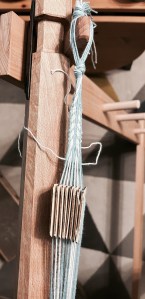
I started off by actually making a tablet woven starter band, which I did not do on my first weaving attempt (mostly because I just wanted to get started weaving fabric). In prehistoric examples, it is normal to startthis way, either using tablets or a repp woven band. Incidentally, there are no rigid heddles known from prehistoric Northern Europe, so it is likely that they were using string heddles, like what is used on the warp-weighted loom. Essentially, the weft from the band becomes the warp on the warp-weighted loom, when it is attached to the warp beam.
In this case I wasn’t too worried about the design of the band, I just wanted something that was quick and easy and this looked like it ticked both those boxes (I really need to sit down and work on tablet woven bands at some point in the near future!). I made the band 70cm long, which is much longer than I needed but I wasn’t sure how much I would need to stabilise it when I sewed it to the cross-beam.
Setting up the warp-weighted loom
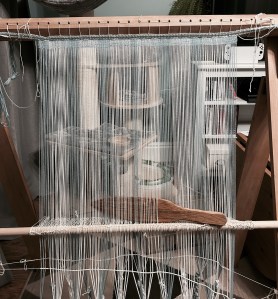
On the tablet woven band I had 268 warp threads that measured about 51cm across. Each of my cloth bag weights was about 472g each and when I divided them up across the warp, each warp thread had about 34g weighing it down.
Weaving
Once it was all set up, I got to weaving. I was trying to do a simple cheque pattern but I kept forgetting to measure the width of the section I wove so the stripes are little bit off. I did find the vertical stripes to be both useful (because I could keep an eye on how much the warp was drawing in towards the centre) and not useful (because I was getting obsessed by the yarns drawing in towards the centre!). So, yes, this attempt still suffered from this issue but not nearly as bad as in my previous attempts.
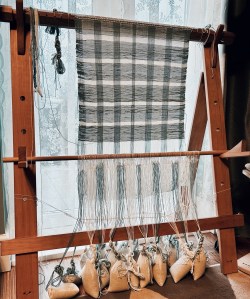
The other issue I had was joining in new yarn. This might just be because I’m new to weaving, but I was finding it difficult to make the weft look nice where I had to switch to a different colour or I ran out of the yarn I was using. This might also be because of the size of the yarn I was using and because it was cotton? I think there’s still a few fundamentals that I need to learn.
Finishing
When I wove enough to make a decent tea towel I took it off the loom and hemmed the end with a zig-zag stitch on my sewing machine. I then folded the end twice to make a tube, and sewed that down. I did something similar with the ends of the band but left one of the loops longer so that I could hang it up if I wanted to.
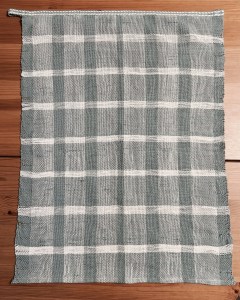
Before I washed it, the finished dimensions were about 49cm across at the top and 48.5cm at the bottom and it measured 63cm in length. My sett was about 5.6 threads/cm in the warp and the same in the weft.
After washing, both the warp and weft definitely relaxed a bit and it all shrunk a little. This really helped with the selvedges, which had become a little bit sparse, and the shrinking made the weft thread changes less horrible looking.
I can definitely say that this is the fanciest (and most absorbent) tea towel in my kitchen!
 Ancient Textile Craft
Leave a comment