
Site: Skipwith Common
County: North Yorkshire
Present location: Yorkshire Museum (YORYM : 2007.6137)
Preservation type: Organic
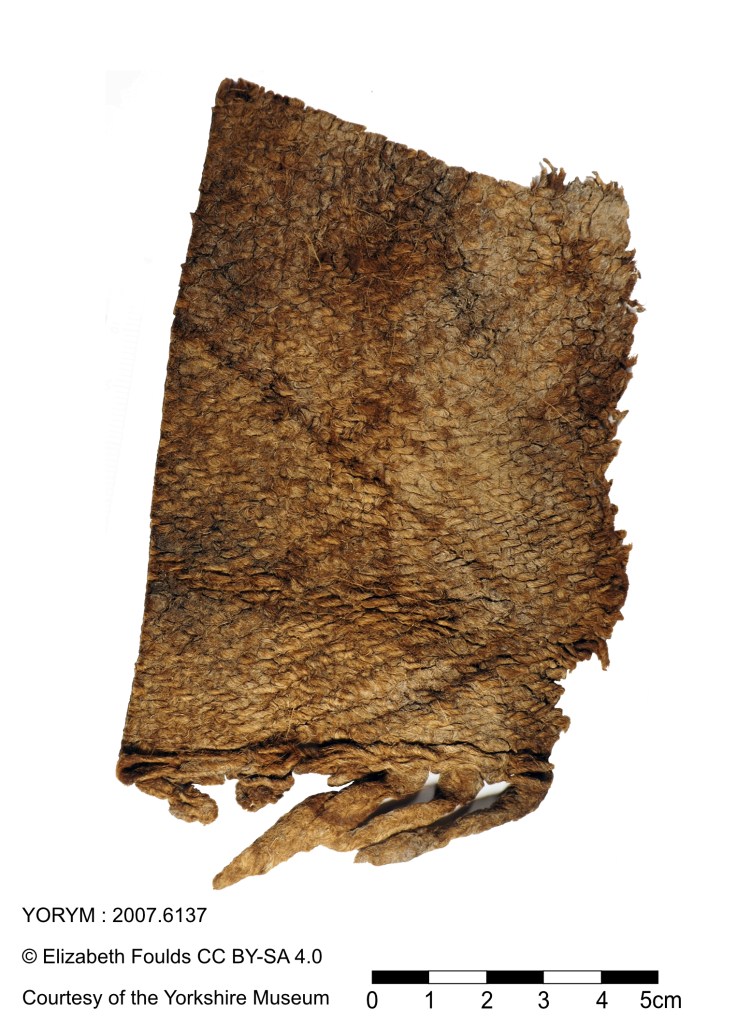
Dimensions: 15.5cm x 8.5cm
Material: Wool (‘hairy fleece’)
Technique: Woven
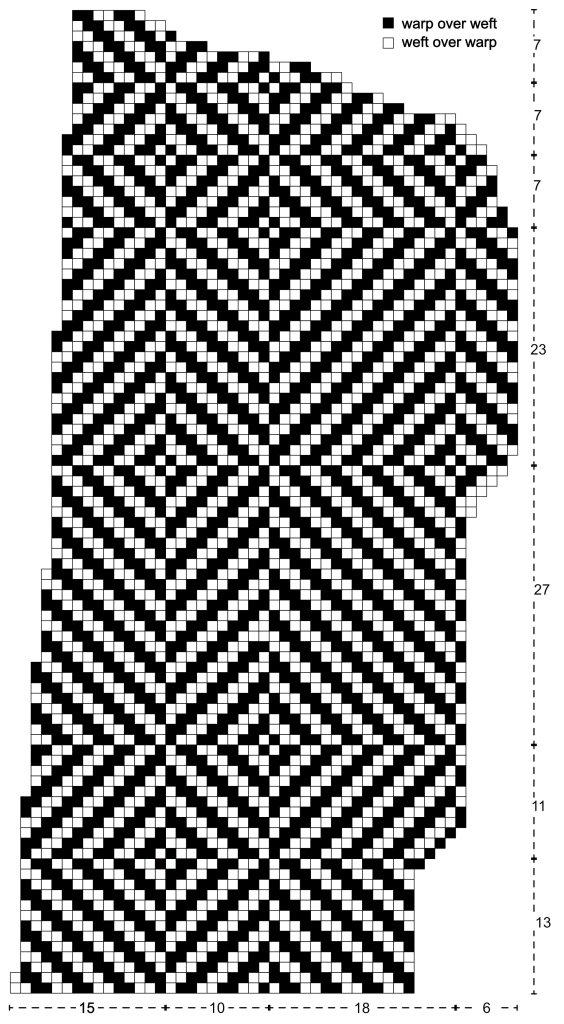
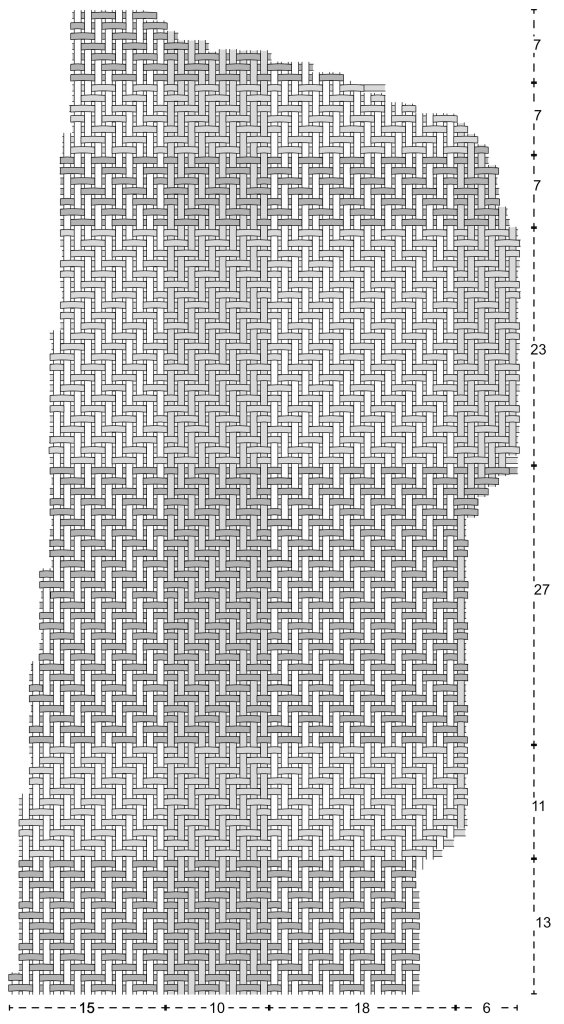
Structure: 2/2 broken diamond twill with reverses after 14+, 10, 18, 6+ warps and 7+, 7, 7, 23, 27, 11, 13 wefts
Warp/weft can be identified: Yes
| Warp | Weft | |
| Spin direction | Z-spun singles | Z-spun singles |
| Twist angle (deg) | 50 | 50 |
| Diameter | 0.8mm | 1.0–1.3mm |
| Ends/cm | 5 | 5 |
Textile finish: matted, possibly from deliberate fulling
Selvedge: not present
Starting border: not present
Ending border: fringe (3.5cm long). Groups of 5 or 6 warp threads are bound with a Z-spun thread in a crochet stitch (chain stitch?)
Damage/Wear: none
Additions/Alterations: cut along two edge, this may have occurred after excavation.
Context: Discovered in 1817 by Mr Stillingfleet and thought to have come from a square barrow. No other details known.
Dating: Assumed to be Iron Age.
Reference:
Henshall, A.S. 1950. Textiles and Weaving Appliances in Prehistoric Britain. Proceedings of the Prehistoric Society 16, pp. 138. doi: 10.1017/S0079497X00018995.
Stead, I.M., 1965, The La Tene Cultures of East Yorkshire, The Yorkshire Philosophical Society, York.
Walton, P. 1983. Cloth from a British barrow on Skipwith Common 1817. Unpublished report held in Yorkshire Museum archive.


Leave a Reply