
This post continues on from my previous post about making a flax break. In this post, I’m going to share how I made hackles for processing flax in the hopes that it helps others out there looking to make their own tools.
A lot of the antique flax hackles I’ve seen online are made with square nails with very sharp points set into blocks with various spacings to get different grades (e.g., coarse, medium, fine). I’ve seen various discussions online about the shape of the nails for flax hackles, with some saying that the finest quality of flax can only be obtained from square nails. I, of course, would love to have a set of antique hackles, or even just to try out, but I haven’t been able to find any in the UK yet. One day I may have to import some from another country. I also considered commissioning a blacksmith to make me some square nails and this might be an option for the future. The only new hackles I could find are sold by Wingham Wool Works, which are sold in three grades but are made with round nails. They are also rather expensive (£495 for all three)! I’m sure that the cost reflects the production of what is probably a very niche tool but as flax processing is new to me and I wasn’t sure if I wanted to do a lot of it, I decided to make my own and at least go through the process and see what I could do just by using plain ‘ol nails from B&Q.
Materials and dimensions
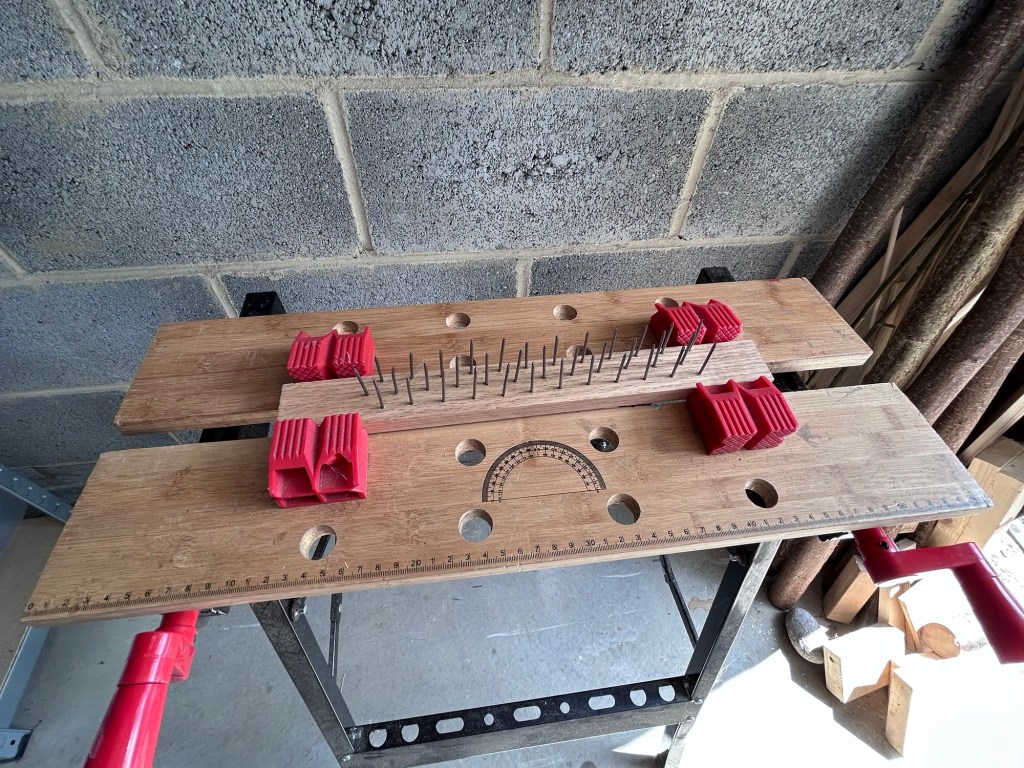
- Oak strip wood, mine was 34mm wide and 10mm thick
- Nails, I used two types: 2mm diameter & 50mm long (medium and coarse); 1.5mm diameter and 30mm long (fine)
- Drill and bits of the same size as the nail sizes (maybe also some spares)
- Hammer
- Print outs of the templates
Construction steps
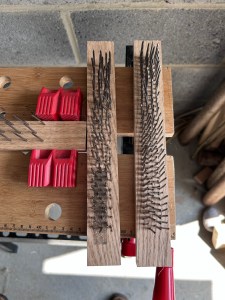
I used the larger nails for the coarse and medium hackle but used the smaller nails for the fine hackle.
1. Cut oak wood to the required lengths. Mine are about 34cm long.
2. Drill holes. Tape down the template and start drilling holes. Oak is a hardwood, so don’t go too fast, as otherwise the drill bit can over heat and become brittle and break.
3. Hammer nails into the holes.
And that’s it! I clamped mine into place on my workbench to keep it from moving around while I worked.
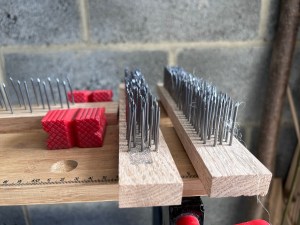
So far, I’ve hackled about half of my stook from Flaxland UK and my homemade hackles seem to be working really well. I’m actually surprised at how well they seem to be working but please do keep in mind that I don’t have any other hackles to compare to. It might not be the finest but I think my longline fibre isn’t too bad. I’m surprised at how soft it is.


Leave a comment